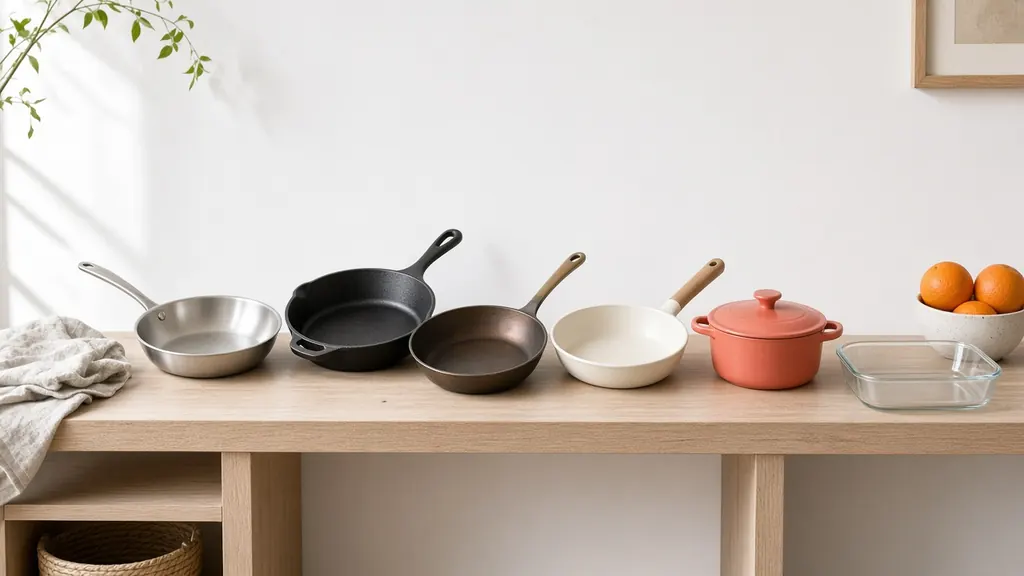
Quick take
These materials are the common non-PTFE options. “PTFE-free” is not the same as “free of every concern.” Each material has its own trade-offs, so this page lists what sources say about PFAS and what else is documented, along with what we could not find. We do not rank materials or call any of them “safe.” Start with what PFAS-free cookware means if the terms are new.
At a glance
| Material | PFAS: what sources say | Other documented points | Evidence gaps |
|---|---|---|---|
| Stainless steel (uncoated) | The Ecology Center lists it among durable uncoated alternatives that avoid PTFE’s lifecycle concerns.2 | A 2013 study found nickel and chromium leached into tomato sauce in simulated cooking.3 Food can stick unless the pan is preheated and oil or butter is used.2 | No PFAS lab results for specific stainless pans found. |
| Cast iron (uncoated, seasoned) | CR says many uncoated pans, including cast iron, are unlikely to contain PFAS.1 | Needs seasoning with oil and may need reseasoning.2 Iron transfers into food, especially acidic or moist food cooked longer.4 | No PFAS lab results for specific cast iron pans found. |
| Carbon steel (uncoated, seasoned) | CR says many uncoated pans, including carbon steel, are unlikely to contain PFAS.1 | CR says cast iron and carbon steel develop a seasoned patina that can become like a nonstick coating.1 | CR is the only source we cite for carbon steel. We did not find leaching studies specific to it. |
| Ceramic-coated nonstick | In CR’s 2022 test, two ceramic-coated pans with PTFE-free claims had none of the 96 PFAS it looked for.1 The Ecology Center’s coating analysis found “silicon dioxide” coatings on the two pans labeled PTFE-free.2 | The Ecology Center says ceramic coatings are known for short useful lifespans.2 CR found the ceramic pans matched PTFE pans on cooking evenness and food release, with a slight difference in its durability test.1 | Two ceramic pans in one CR test. Coating composition beyond PFAS and PTFE not addressed by our sources. |
| Enameled cast iron | The Ecology Center lists it as an option “often marketed as nonstick.”2 | Enamel is a glass-like coating fired onto the iron and can chip if struck. Avoid sudden temperature changes and heating it empty.6 | No PFAS test of enameled cookware found, and no test of the enamel’s composition. |
| Glass (bakeware, storage) | The Ecology Center lists glass for baking.2 Iowa State Extension says glass is preferred because “there are no hazardous materials to leach into food.”7 | Can shatter from thermal shock. Not all “Pyrex” is the same glass.7 | No PFAS test of glass cookware found. |
Stainless steel
What it is. An uncoated steel alloy. There is no coating layer on the cooking surface.
See the evidence on stainless steel
PFAS. The Ecology Center names stainless steel, with glass and cast iron, as “durable, uncoated” options that avoid the lifecycle concerns it raises about PTFE.2 Neither it nor CR ran PFAS tests on uncoated pans. Their test sets were nonstick pans.12 The expectation that stainless steel is free of PFAS comes from how it is made, not from a published lab result.
Other points. A 2013 study (Kamerud and colleagues) simulated cooking tomato sauce in stainless-steel cookware and reported that nickel and chromium leached into the food. New cookware leached the most, and leaching declined and stabilized with repeated use.3 We cite it so you are not surprised, not to say whether the amounts matter for you. If you have a concern about metal exposure, ask a clinician.
Handling. The Ecology Center says the cook can avoid sticking by using oil or butter and heating the pan sufficiently before adding food.2
Cast iron
What it is. Iron cast into a pan, usually seasoned with baked-on oil.
See the evidence on cast iron
PFAS. CR says many uncoated pans, including cast iron and carbon steel, are unlikely to contain PFAS.1 As with stainless steel, this is an expectation from the material, not a lab result on a specific pan.
Other points.
- The Ecology Center says cast iron pans can be safely heated to much higher temperatures than PTFE-coated pans, need seasoning with oil or shortening before first use and may need reseasoning.2
- A 1986 study cooked 20 foods in iron versus non-iron utensils. It reported that 90% of the foods had significantly more iron after cooking in iron, and that acidity, moisture and cooking time increased iron uptake. Results varied between skillets, likely due to prior use.4
- Iron is a nutrient with an upper limit, and some people have a hereditary condition (hemochromatosis) in which iron builds up. The NIH fact sheet discusses supplements, not cookware, so we make no claim about cookware and these conditions. If either applies to you, ask your clinician.5
Carbon steel
What it is. A steel pan, uncoated and seasoned like cast iron, usually thinner and lighter.
See the evidence on carbon steel
PFAS. CR groups carbon steel with cast iron as uncoated pans that are “unlikely to contain PFAS,” and says both develop a seasoned patina that can become like a nonstick coating.1
What we could not find. Carbon steel has the thinnest evidence of any material here. CR is our only cited source. We did not find a test of carbon steel for PFAS or a leaching study specific to it. Treat it as “expected from the material” rather than “documented.”
Ceramic-coated nonstick
What it is. A pan, usually metal, with a mineral-based “ceramic” nonstick coating. See the label decoder for how “ceramic” and PTFE-free claims showed up on labels in published tests.
See the evidence on ceramic-coated nonstick
PFAS. This is the material with the most direct test evidence among the alternatives, but it is still thin.
- Consumer Reports (2022) scraped coating samples from two ceramic-coated pans carrying PTFE-free claims, the Our Place Always Pan and the Red Copper pan. It did not detect any of the 96 PFAS it looked for. CR also says it is “theoretically possible” that other PFAS are present, since there are thousands.1
- The Ecology Center (2020) found that the two cooking pans labeled PTFE-free (Goodful Titanium Ceramic and Cuisinart Green Gourmet) had silicon dioxide coatings, which it says can be considered a ceramic, matching their labels.2
- CR says most of the scientists it consulted were not surprised by the result, because PFAS are not needed to make nonstick ceramic cookware. It quotes a Duke University chemist: “Ceramic pans, those should be [PFAS] free.”1
Other points. The Ecology Center says ceramic coatings are known for short useful lifespans.2 CR reports that its ceramic and PTFE pans were “neck-and-neck” on cooking evenness and food release, and that in its steel-wool durability test a few ceramic pans scored Excellent while many PTFE pans did.1
Limits. Those results are for specific pans bought in 2020 to 2022. They say nothing certain about other brands or later production. A coating test or a clear materials statement from the brand is what turns a “ceramic” label into evidence.
Enameled cast iron
What it is. Cast iron with a glass-like enamel fired onto the surface.
See the evidence on enameled cast iron
Points from sources. America’s Test Kitchen describes enamel as a glass-like coating, fired on like a glaze on pottery, that cracks or chips if sharply struck. It advises against dramatic temperature changes and heating an empty pot, and says the plain cast iron under a chip is “perfectly safe to cook with.”6 The Ecology Center lists enameled cast iron as a versatile option often marketed as nonstick.2
What we could not find. We found no PFAS test of enameled cookware and no testing of what the enamel contains. We have not researched whether specific products’ enamels contain heavy metals. Ask a brand for its materials and compliance documentation, and treat anything without a source as unknown.
Glass
What it is. Glass bakeware and storage, either borosilicate or tempered soda-lime glass.
See the evidence on glass
Points from sources. Iowa State University Extension says glass is preferred because “there are no hazardous materials to leach into food,” but notes glass bakeware can shatter, crack or explode under thermal shock.7 It explains that U.S.-market “pyrex” (lowercase) is tempered soda-lime glass that handles heat less well than borosilicate, and reports that in 2010 Consumer Reports found newer glass shattered when moved from a hot oven onto a wet granite counter.7 Cautions the page relays from CR include not using glassware on the stovetop or under a broiler, not adding liquid to hot glassware, and discarding dishes with chips, cracks or scratches.7
What we could not find. No PFAS lab test of glass cookware, and we did not assess decorations, printed designs or lids, which may be made of other materials.
Beyond PFAS: lead in some imported cookware
This is not a material comparison, but it matters if you buy secondhand or imported. The FDA warns retailers and consumers not to sell or use certain imported cookware made from aluminum, brass, and aluminum alloys known as Hindalium/Hindolium or Indalium/Indolium that has been shown to leach lead under conditions mimicking use. It says young children, women of child-bearing age and those who are breastfeeding may be at higher risk.8 The FDA keeps a product list that it has updated since August 2025, and says other products may also be affected.8 If you have a concern about lead, the FDA advises contacting a health care provider.8
Not medical advice
This guide is general information. It does not diagnose or advise on any health condition or on how much of any metal is safe for you.
What we don’t know
- PFAS test results for uncoated, enameled or glass cookware. The published tests we found covered nonstick pans.
- Whether any specific product’s coating, enamel or glaze contains other substances of concern.
- How results would change with wear, high heat or long use. The ceramic results are from pans in new condition.