Quick take
A PFAS filter only earns its keep if PFAS are in your water, so test first. Then buy a model certified for PFAS, lean toward under-sink reverse osmosis or dual-stage systems if you want the strongest option, and replace cartridges on time. We don’t endorse brands. We tell you which labels to look for.
What to do
- Check your water first. EPA says a filter may not be useful if PFAS aren’t measured in your water or are below federal limits. Call your water provider.1 Our guide to finding out what’s in your tap water walks you through it.
- Look for a PFAS claim from an accredited certifier. EPA says to look for NSF/ANSI 53 or 58 PFAS reduction claims.1 Check the exact model in the certifier’s database, not just the box. Our certification guide shows how.
- Match the type to the stakes. In one field study, under-sink dual-stage and reverse osmosis filters showed near-complete removal. Other carbon filters were variable.4
- Replace cartridges on the maker’s schedule. EPA says filters only work when they’re maintained.2 A 2024 review says improperly maintained carbon systems might even raise PFAS levels in the water.5
- Be cautious with whole-house carbon filters for PFAS. In the same field study, four of eight systems showed higher PFAS after filtering.4 If you have one, test the water that comes out.
- Don’t buy a shower filter to cut PFAS. We found no test showing they do. Here’s why: do shower filters remove PFAS?
- Want to filter for microplastics? Look for a fine membrane. In one small test, only the membrane devices removed most particles.10 More in our microplastics guide.
Filter types at a glance
| Type | How it works | What the evidence says for PFAS | Watch-outs |
|---|---|---|---|
| Pitcher or bottle | Granular activated carbon (GAC), sometimes with ion exchange | A 2025 lab test of 12 pitcher and 5 bottle filters found average removal from 31% to 99% for the sum of 20 PFAS. Nine filters reached over 80%.6 | Results vary by model, so certification matters. Small cartridges wear out. |
| Faucet-mount or countertop | Activated carbon | “Variable” in the field study. It included only two faucet filters and one countertop unit, so treat it as a hint.4 | Buy only a model certified for PFAS. |
| Refrigerator filter | Activated carbon block | “Variable” in the same study.4 | Not all fridge filters carry a PFAS claim. |
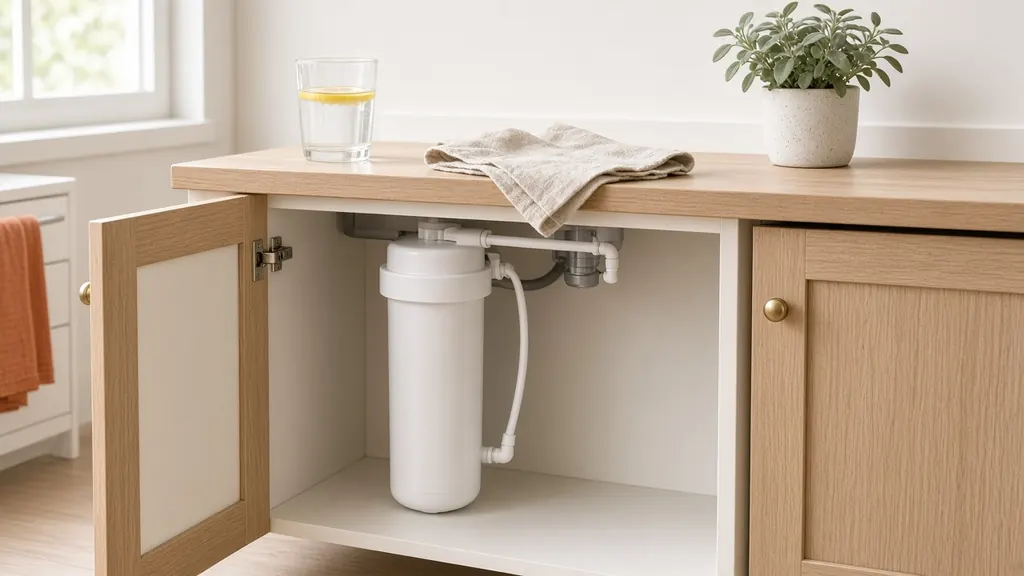
| Under-sink, dual-stage | Two stages of filter media in a row | Near-complete removal for all PFAS tested in the field study.4 | Needs space and a plumbing hookup. |
| Under-sink reverse osmosis (RO) | A membrane, often with carbon prefilters | Near-complete removal in the field study.4 EPA found GAC, ion exchange and RO systems can greatly reduce PFAS.2 | EPA says RO wastes about one gallon of water per gallon treated.2 |
| Ion exchange resin | Beads that capture PFAS | EPA lists it as an effective option alongside GAC and RO.12 | Wears out over time. |
| Whole-house (point of entry) | Large activated carbon tank | Variable. Four of eight systems showed higher PFAS after filtering.4 | Test the filtered water. Saturated media may release PFAS back, per the study’s authors. |
| Shower | Various media | We found no peer-reviewed PFAS test and no PFAS certification. | See our shower filter article. |
EPA puts the cost of GAC filters at $20 to $1,000, not counting maintenance.2
See the evidence: field study, review and EPA guidance
The field study. Duke and NC State researchers tested point-of-use and whole-house filters in 73 North Carolina homes (61 in central and 12 in southeastern North Carolina). All under-sink dual-stage and reverse osmosis filters showed near-complete removal of every PFAS measured. Other carbon filters were variable: long-chain PFAS were removed at about 60–70% and short-chain PFAS at about 40%. Among eight whole-house carbon systems, four increased PFAS levels in the filtered water. The authors suggest saturated media may release PFAS back.4 Samples were small for some filter types, and we don’t know whether any tested model carried a PFAS certification.
The review. A 2024 review says that although many home PFAS filters are lab-tested and often certified, their real-world performance has barely been checked. Only five peer-reviewed studies measured removal in real-life settings, results were inconsistent, and short-chain PFAS were a particular weak spot.5
EPA. EPA says GAC, ion exchange and RO can be effective, that maintenance is critical, and that its own research found these systems can greatly reduce PFAS.12 It also says current certification standards (as of April 2024) don’t yet indicate a filter will remove PFAS down to the levels EPA has now set.2
Consumer Reports. CR also advises choosing independently certified filters (NSF/ANSI 53 or 58) rather than relying on a maker’s claim.9 We don’t repeat its brand-by-brand picks.
Why certification matters
A claim on the box is the seller’s word. A listing from an accredited certifier means an outside lab tested that exact model, for the claims listed. NSF/ANSI 42 covers aesthetic effects such as taste and chlorine, while 53 covers health effects.7 EPA names five ANSI-accredited certifiers, including NSF.1 NSF says its standards 53 and 58 now carry PFAS claims, including a “Total PFAS” claim with a combined limit of 20 parts per trillion.8 Even so, EPA’s legal limits for two PFAS, PFOA and PFOS, are 4.0 ppt each.3 That gap matters: EPA says certification doesn’t yet guarantee that filtered water meets the new limits.2
Where the rules stand
As of October 30, 2026, EPA’s 2024 limits of 4.0 ppt for PFOA and PFOS are on the books. EPA has proposed giving water systems that request it two more years, until 2031, to comply.312 The comment period closed July 20, 2026, and we haven’t seen a final rule. EPA is also proposing to rescind its limits for PFHxS, PFNA, HFPO-DA and the Hazard Index.3 Rules in flux are another reason to test your own water. Our tap water guide explains the details.
What filters do for microplastics
It depends on the filter, and the evidence is thin. In one test of pour-through devices on spiked water, two membrane-filter devices removed 78–86% of PVC and 94–100% of PET fragments. A device that used only granular activated carbon and ion exchange released more particles than it took in. Only three devices were tested, the particles were 30–1,000 µm, and the study didn’t cover nanoplastics.10 Among the claims NSF/ANSI 58 lists for reverse osmosis systems, we didn’t see microplastics.11 Details are in our microplastics guide.
Not medical advice
This guide is general information about home water treatment. It doesn’t say whether your water is safe to drink. If you’re pregnant, caring for an infant or have a health concern, ask your clinician or local health department.
What we don’t know
- How well certified home filters work in real homes over their full cartridge life. A 2024 review found few real-world studies.5
- Whether current certifications will be updated to match EPA’s 4.0 ppt limits, and when. NSF says it’s working on updates.8
- Whether specific models do better or worse than their type averages. We don’t rank brands.
- Whether any home filter removes nanoplastics. We found no test.
Next: how to read a water filter certification and what’s in your tap water.